From Drama to Empowerment: Transforming the Victim, Rescuer & Persecutor Roles into Conscious Creation
A guide to stepping out of emotional reactivity and into empowered relating
You can be highly self-aware and still find yourself caught in relational patterns that drain your energy.
You take responsibility for everyone. Then resent how much they need you. You become controlling when standards slip — or quietly powerless when a situation refuses to change.
These reactions can appear in relationships, leadership, teams, and business. They look different on the surface, but underneath, they often follow the same pattern.
The Drama Triangle, introduced by psychiatrist Stephen Karpman, offers a powerful framework for recognising that pattern — and understanding how we move from unconscious reaction back into conscious choice.
I use the Drama Triangle and Empowerment Dynamic here as reflective coaching models—not as diagnostic tools or frameworks for interpreting abuse.
The Drama Triangle:
The Loop of Disempowerment
The Drama Triangle was introduced by psychiatrist Stephen Karpman in 1968 as a model of shifting interpersonal roles: Victim, Rescuer, and Persecutor. Each role may feel justified in the moment, but all three keep us in the same energetic loop: separation from responsibility, boundaries, and truth. It is a reflective model from transactional analysis, not a clinical diagnosis (Read Karpman’s original Drama Triangle article).
The Victim
Feels powerless, stuck, or wronged.
Believes life is happening to them.
May unconsciously attract rescuers or persecutors to confirm their story.
Shadow belief: “I can’t handle this on my own.”
Hidden need: To feel supported and capable.
The Rescuer
Jumps in to help, fix, or save others.
Gains a sense of worth through being needed.
Often ends up over-giving, exhausted, or resentful.
Shadow belief: “If I don’t help, I’m not valuable.”
Hidden need: To feel safe in letting others have their own experience.
For high-achieving women, the Rescuer role can be particularly difficult to recognise. It can look like leadership, competence, or simply having high standards.
You become the person who anticipates every problem, carries what belongs to other people, and holds the entire system together. Then resentment builds — and the Rescuer quietly moves into Victim or Persecutor.
The pattern is not a lack of emotional intelligence. It is responsibility without boundaries.
The Persecutor
Uses control, blame, or criticism to feel powerful.
Often a protector of deep hurt or fear.
Keeps distance through dominance instead of vulnerability.
Shadow belief: “If I let go of control, I’ll be hurt again.”
Hidden need: To feel safe in softness and mutual respect.
No matter where we enter the triangle, we often rotate through all three roles.
A Victim becomes a Persecutor when they lash out, the Rescuer turns Victim when their help isn’t appreciated — and the cycle continues.
These roles are best used as a reflection tool, not a label. If a particular reaction feels familiar, explore why your partner can trigger you and what that reaction may be pointing toward.
The Shift: Moving into The Empowerment Dynamic (TED)
The antidote to the Drama Triangle is The Empowerment Dynamic, created by David Emerald. He developed The Empowerment Dynamic as an alternative framework using the roles Creator, Challenger, and Coach. Like the Drama Triangle, it is most useful as a framework for reflection and conscious choice—not as a label for yourself or others (About The Empowerment Dynamic and its origins).
It transforms the same relational energies into more empowered roles that cultivate responsibility, collaboration, and conscious creation.
This shift also has a relational-regulation dimension. HeartMath Institute uses the term social coherence to explore how individual self-regulation can support more coherent communication, connection, and group functioning (HeartMath Institute on social coherence).
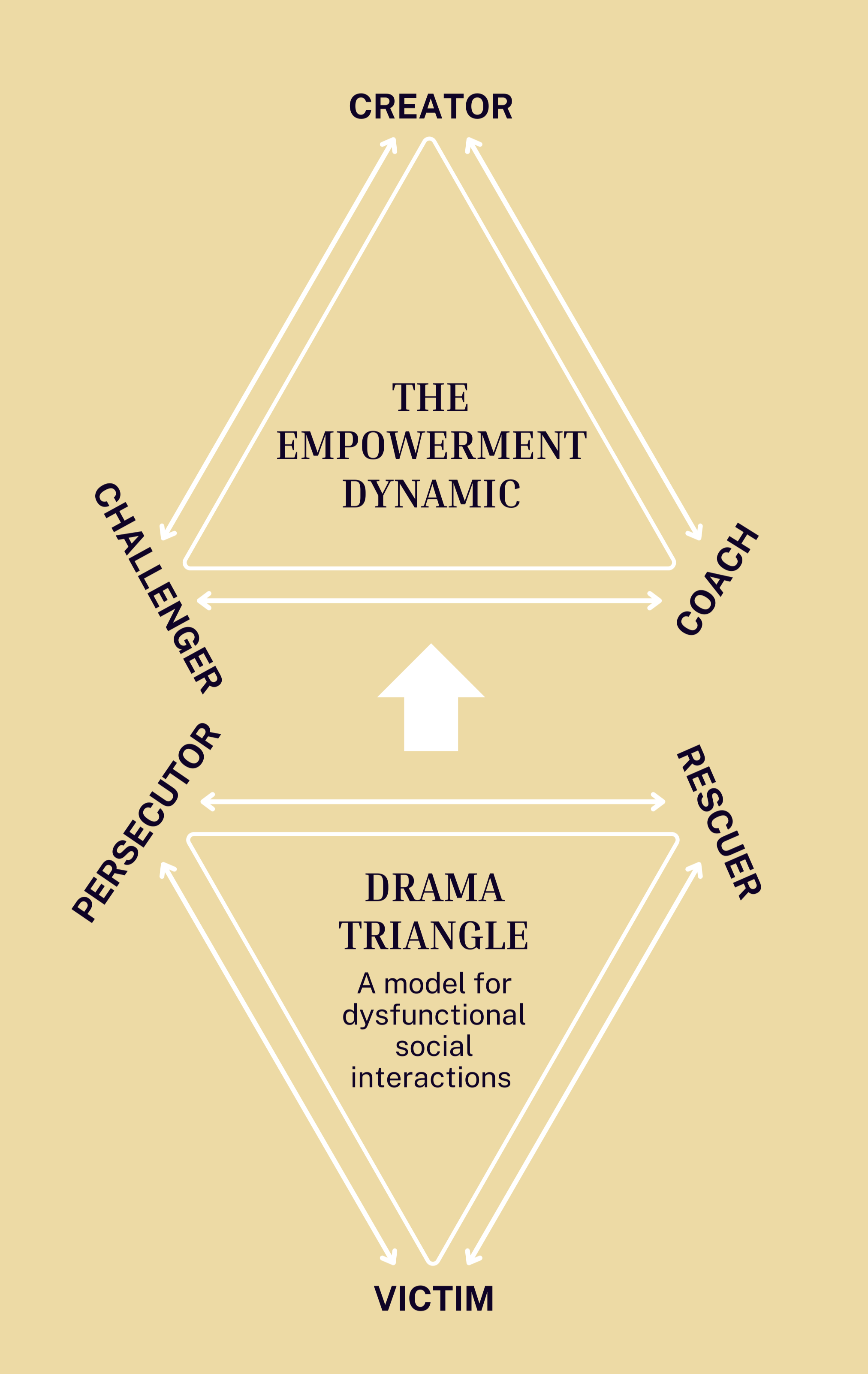
Victim → Creator
The Creator takes responsibility for their inner state and choices.
Instead of asking “Why is this happening to me?”, they ask, “What do I want to create now?”
They act from possibility, not helplessness.
Mantra: “I choose to respond with creativity and intention.”
Practice: Reconnect with your body — every breath is a new beginning.
Rescuer → Coach
The Coach supports others’ empowerment rather than saving them.
They hold compassionate space and ask guiding questions that awaken self-trust.
Mantra: “I trust others to find their own wisdom.”
Practice: Replace fixing with curiosity — “What feels true for you right now?”
Persecutor → Challenger
The Challenger speaks truth with integrity.
They call forth growth — not through blame, but through clarity and accountability.
Mantra: “I can hold both compassion and truth.”
Practice: Ground before you speak; invite evolution, not punishment.
Living in the Empowerment Dynamic
When you step into TED, you move from unconscious reaction to conscious creation.
Your nervous system relaxes.
Boundaries strengthen.
Relationships become honest, balanced, and growth-oriented.
You stop performing for love — and start creating from love.
Imagine how your life expands when you:
Respond instead of react.
Support without losing yourself.
Speak truth with tenderness.
This is emotional maturity in motion — the essence of inner sustainability.
A Practice for Stepping Out of the Triangle
When you notice tension or conflict, pause and ask yourself:
Which role might I be in right now?
What do I truly need?
How can I respond as a Creator, Coach, or Challenger instead?
A single conscious breath can create enough space to notice the role—and choose a different response.
Repeated relational roles can sometimes make more sense when viewed alongside the early strategies we learned to stay connected. Read how inner child healing can change relationship patterns.
Closing Reflection
You were never meant to stay in the loop of blame, rescue, or control. Every moment offers a genuine choice — to step off the triangle and respond from a different place. That is not a small shift. It is what changes the quality of every relationship and every decision that follows.
For high-achieving women ready for more
Your next level doesn’t require pushing harder.
It requires feeling safe enough to expand.
This is the work inside The Expansion Reset.
Continue Exploring
You may also enjoy these articles:
→ How Each Generation's Parenting Shaped the Subconscious Patterns You're Still Carrying
→ Why Your Partner Triggers You — And What It Reveals About Your Professional Patterns Too
→ The Emotional Pattern Behind Every Success Ceiling
Sources and further reading
Stephen Karpman’s original Drama Triangle article
The Empowerment Dynamic: framework and origins
HeartMath Institute: Social Coherence
About the Author
Written by Ellen Øgaard, Compassion Key® Certified Practitioner and creator of The Expansion Reset — a private 10-week mentorship for high-achieving women ready for their next level of success.